What is DHL
If we go deeper into what is Health Lietracy (HL), we refer to the definition developed by the HLS-EU Consortium, which is based on a comprehensive analysis of 17 definitions and therefore bridges across the multiple aspects attached to the concept of health literacy:
Health literacy is linked to literacy and entails people?s knowledge, motivation and competencies to access, understand, appraise, and apply health information in order to make judgments and take decisions in everyday life concerning healthcare, disease prevention and health promotion to maintain or improve quality of life during the life course.
Our project
Know our objective developing this project
Consortium
Meet the partners behind the project
In this conceptual model, we can find reference to three main pillars: obtaining, understanding and applying health information. Each of these abutments is a necessary and essential pillar, if we lack of any of them we would not achieve our literacy goals. Adding the term “digital“, obstructs and/or facilitates each of the phases because it involves the use of ICTs as environments where this process develops. The roles or actors in this process are mainly two: those in need of health information (patients, family, caregivers, ?) and health information providers (doctors, nurses, dentists, pharmacists, public health workers, librarians and health empowered communities); in adition, there is a complementary external role integrated by rules makers (politician, lawmakers, ?).
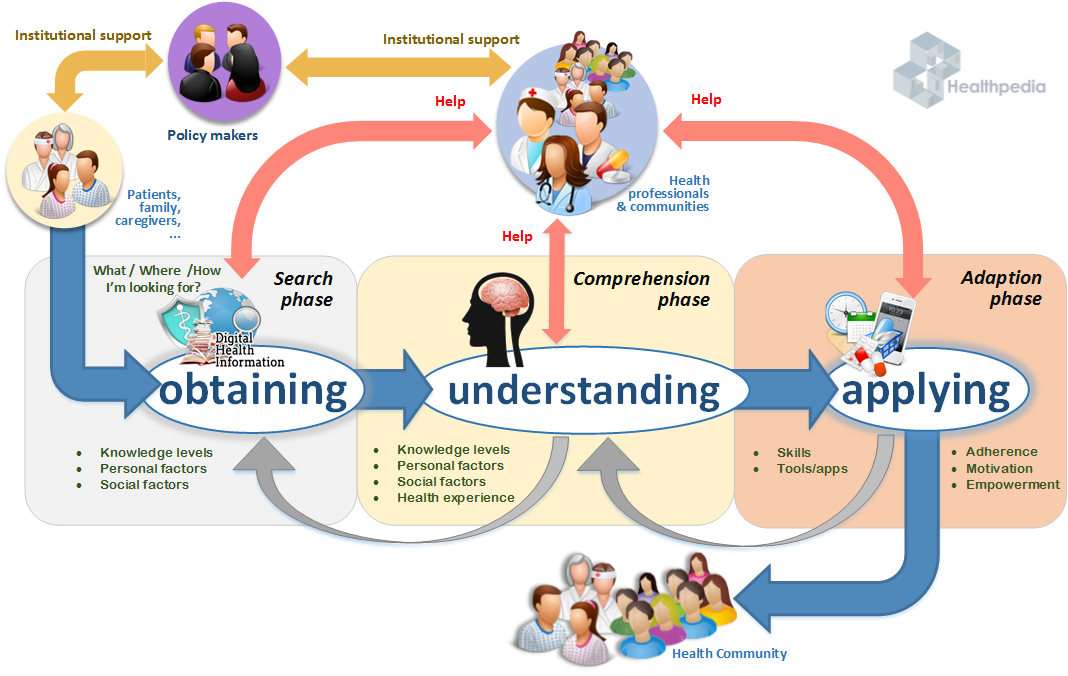
It is the process where we acquire the information we are seeking. Although it may seem intuitive, the main process is not only the search, there are many other previous and subsequent factors to consider. First we must ask ourselves some questions: what am I looking for?, where should I look for it and how should I look for it? Social, educational and personal factors affect the result of each question above and can lead to a successful outcome or not. From another point of view, the health information providers should help to teach or indicate where to look.
Once we have the results of the search ideally we will filter out those that are not valid, not understandable, or that may not be suitable. This information filtering should leave us with the most accurate and relevant information. The success of this filtering will again rely on the personal, educational and social factors. To understand and customize the information is a difficult, specific and personal process that also depends on one?s own health experience. From the viewpoint of the health information providers, they can validate potential doubts and provide clear and customized personal communication. They must have a positive attitude towards people bringing information about their own health problems and help to guide them in the best way possible.
Adoption is the differentiating moment between a basic understanding and full literacy. Critical literacy is the practical application of everything learned so far in our daily lives, acquired knowledge, personal skills and tools / applications found, along with the motivation and empowerment towards healthier choices. These choices create healthy habits transforming a person into an empowered citizen. When DHL citizen exhibits their new skills and capabilities, they serve as a model for other citizens, thus becoming part of a community where they function as an information provider, showing and teaching others towards creating an empowered and motivated digitally health literate community.